
 About
About MYINVEST
Key Take-Aways (best on Desktop)
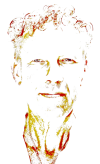
This is the LOGO as I will use it for my partner sites: 1VOID.com, voideffect.com, leerzeit.com and unleer.com. It arose as a 'geometric accident' during the creation of a presentation for a client.
"Take what shows itself to you and make the best of it!"
Lacking a clear idea for a logo, I pushed a photo to 100% contrast and stripped away the background. Perhaps artistically questionable—but it reflects me:
100% contrast.
“Trial and error remain the most reliable guides.”
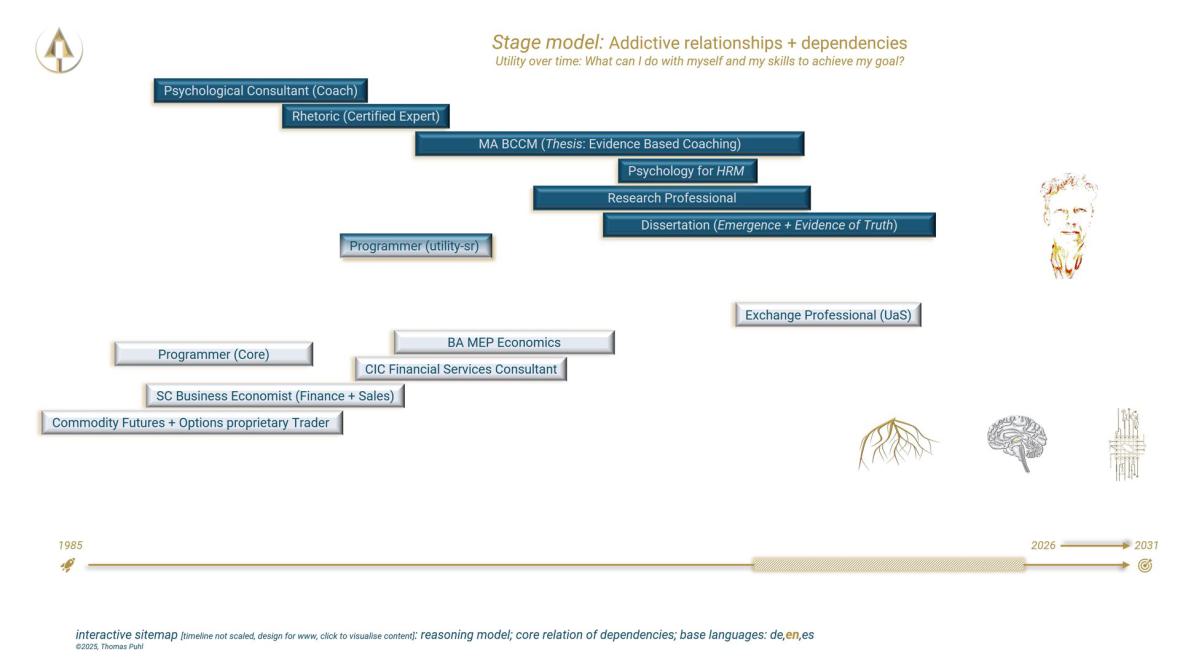
As described above, experiences don’t always need to serve explicit learning goals. Yet everything we’ve lived through has shaped us—often on levels we simply need to reconnect with. This imagemap is meant to offer gentle cues on how you can already support yourself. Sometimes, all it takes is remembering what you once set out to become.
"Remember …" also "the mistakes you made."
"Remember …" also "the mistakes you made."
This symbol serves as a reminder that everything has a natural origin. In an increasingly digital world, reconnecting with the analog roots of our own being becomes essential.
“Ask about the nature of the thing…”
I use this symbol—sometimes combined with others—to signal a return to the core: something native, original, and fundamental.
This symbol is unambiguous. It means only this:
“Think.”
Or:
“See the logic behind everything.”
Nothing exists without an underlying logic—not even within phenomenological experience. Every effect carries its cause within it; no cause exceeds what it produces.
In a broader sense, I also use this symbol to point to a cultural drift—the gradual erosion of independent thinking, reflected in phrases like “fake it till you make it” and a growing copy-paste mentality.
Looking ahead, it will also stand for the concept of ©bmbh—“brain made by humans.” Its full meaning, however, will only reveal itself in the later stages of our current societal transformation.
This symbol stands for AI, technology, automation—and the unfathomable hype around a fully digital life. It also points to a simple truth: every step of digital progress is, in some sense, an analog regression.
“Honor your knowledge and your function.”
I use this symbol to mark autonomously generated digital content. On its own, without any additional symbol, it always carries a question:
“Is this really the right path?”
As you can see from these texts and the way this site is built, I am not opposed to AI or autonomous systems. It is about a reminder:
“Not everything that is simple is simply good.”
There will always be events that pull you away from your goals and dreams. In those moments, it matters to trust that there is still a path leading somewhere meaningful. Sometimes, the path itself becomes the goal—and only then does the goal reveal its true nature.
“Walk the paths you are able to walk; goals may change, but their nature does not.”
Ideas, intuitions, or goals emerge for a reason—touched by Something greater. Every system of dependencies is complete, even if not immediately clear to us. The involution phase is crucial for what follows in evolution. Recognize this:
“Every time has its time, even if we must endure it.”
When the essence reveals itself, the how follows naturally on the what.
“A plan is only as good as the time spent anticipating its failure.”
The field of dependencies always reveals precisely what interacts with what through how. It would be unwise not to look there—and look again:
“Take time to save time.”
“Everything that can show itself can also be shown.”
Everything else is simply another angle on the same field. It may seem unconventional—even nonsensical at times—to present things this way. Yet it can help you, especially at the start, to discover your own perspective on yourself—no matter who, what, why, or how you approach it.
“Have a pleasant time!”
Thomas
Formally, it is an art—analytically, a gateway to influence that can slide into dependency.
“Listen closely to the difference between storytelling and storyselling.”
What appears as a harmless narrative in the realm of imagination can, through a subtle phase shift, become a deliberate strategy within the field of influence.
It is the threshold where a dream meets rational intent—and only one of them knows exactly where it is going.
It is often assumed that everything follows a rule or a plan. Yet in working with people, we tend to overlook a crucial distinction: the difference between object and subject—and how fluidly these roles can shift. A more useful perspective is to think in terms of a dual space.
“If you believe you understand all forms of communication or emotion, ask yourself which ones you have not yet considered.”
If none come to mind, that absence itself defines the field. Everything else lies beyond it—outside the realm of current possibility.
“Learn to distinguish between spaces that are entered and dimensions that move.”
At the end of long processes, we often arrive at insights we could never have anticipated. That is not a flaw, but a reflection of what we call chance—simply a name for connections not yet understood.
“Everything comes together into a coherent whole when the time is right to see it.”
In contrast stands the limit of expression, where meaning can no longer be fully articulated. This occurs when awareness has reached a certain maturity and become deeply interwoven with its web of dependencies.
“That is the phase transition from involution to evolution—when being becomes becoming once again.”
Everything has its two sides. Everything always has more than one perspective.
"Always see both sides of a question to understand an answer."
"Sometimes paths simply do not lead to the goal; then it is wise to turn back and take another branch."
Often, we pursue paths that cannot lead where we intend. The reasons are many—and ultimately beside the point. What matters is recognizing this:
“Attributed honor can never replace dignity; it arises from within as an inviolable inner stance.”
At times, it may seem lost—or simply forgotten that it exists at all. And yet:
“Dignity stands independent of dependency; it only needs to be acknowledged and claimed.”
This passage may feel more profound than the others. I could not render it more simply—because it points directly to something essential, unfiltered, and whole.
At that time I had decided against the formal dissertation and implemented it anyway, because I recognized that I did not want to give up the honor of a title for the freedom of my actions.
At times, it makes sense to adapt existing knowledge to changing conditions—to move with the times. It becomes truly interesting, however, when one recognizes this:
“Core knowledge endures, while the environment often falls into the illusion that innovation can exist without the essence that sustains it.”
“It is fatal when everyone acts, yet no one understands what they are doing.”
“Every form of innovative knowledge ultimately refers back to itself.”
If the underlying patterns remain intact, the form may change—but the substance should not. Some things are already complete as they are, and change may serve everything except the one who alters it.
In the world we live in, generalists—true polymaths—are becoming increasingly rare. Philosophy itself often struggles with what I described in the Gifts section as “Incompetence Compensation Competence.” What remains is the recognition that we have become a society of specialists, each confined to the boundaries of their own field.
In such a landscape, it becomes essential to create pathways that enable genuine interdisciplinary understanding—something that seems to be fading more and more.
Hence:
“Find the balance between complexity and simplicity—so that understanding becomes possible.”
“The middle is the space of communication, a true interface. We only need to learn how to meet there.”
Addiction and dependency entered my life early—long before I could fully grasp their scope or significance. At first, it was excitement: something new, something intense. Nothing seemed to matter as long as the game continued and there were players to keep it alive. It carried the glamour of a world that appeared grounded—and in many ways, still is.
Yet it is also a shadow world, shaped by power and dependency. As its layers grow more complex, its many derivatives begin to obscure what lies at its core.
It draws from spaces of “nothingness” and “emptiness.” The illusion of fullness is the mistake—the belief that it is about accumulation.
To break free from that pull, I defined two simple rules for myself:
“Be the first of your kind.”
“And be the first to leave.”
Anything else, in the end, serves the very spaces from which others draw.
Although I was among the first in my field, my influence steadily declined. I had failed to properly understand—and refine—my own intuition.
“Everything can be structured and operationalized.”
“All levels behave according to their nature in equal measure.”
“Nothing escapes the laws of logic.”
There is more that could be said, but the essence can be reduced to a single principle:
“Seek the most effective perspective—and shape it with both efficiency and precision.”
Today, this has become a core element of my thinking: continuously rotating diverse perspectives around the axes of effectiveness and efficiency.
In essence, everything here unfolds between two poles: top-down and bottom-up. The surrounding boundary conditions define a status quo that is meant to be maintained.
“For more, see the countless entries of any economics lexicon.”
This field forms one of my more solid foundations—yet also one of the least engaging. Every causal chain, with its causes and effects, is effectively predetermined; more precisely, it must be. That is the nature of this domain.
At this point, I follow my own principle of neutrality—and leave it without further comment.
After a crisis, the question became how to move forward. With some research—and a return to what was already known—this much became clear:
“There is always a way; it only needs to be found.”
“It is not always the most direct path that truly leads to the goal.”
“If needed, bridges can be built between worlds.”
And more precisely:
“The shortest distance between two points is a circle.”
Briefly:
"Do not conform to conventions if you do not want to."
"Wrong paths lead everywhere except to the goal."
Today I know:
"If the path proves wrong, then end it."
Hawai’i, November 2025
Sometimes, you discover what you could never have anticipated.
“Take it—and integrate it into yourself.”
In this way, things fall into place naturally, revealing that shorter paths to a goal can exist.
For more, click the Vita button above and explore the section “The Conclusion” with its sub-branches.
The bridge between being and becoming:
(Zero-Point Field)
‘anything is right if done in the right light’
‘spirit always listens’ (but may not answer)
‘spirit is (always) ready to help’ (but you need to act)
Freely after ‘William’ Keahi Lihau I'aukea
Kailua-Kona, HI
Final...
SOCIAL MEDIA BIO EXPLAINED
→ Mentor for Dependencies— Self-evident on this site.
→ Lobbyist for Secular Spirituality
Advocating spirituality detached from religion: mindfulness in schools, humanist ethics, rational meaning-making.
→ Expert Generalist (T-Shaped)
Broad knowledge + deep emergence expertise. Thrives blending perspectives across fields.